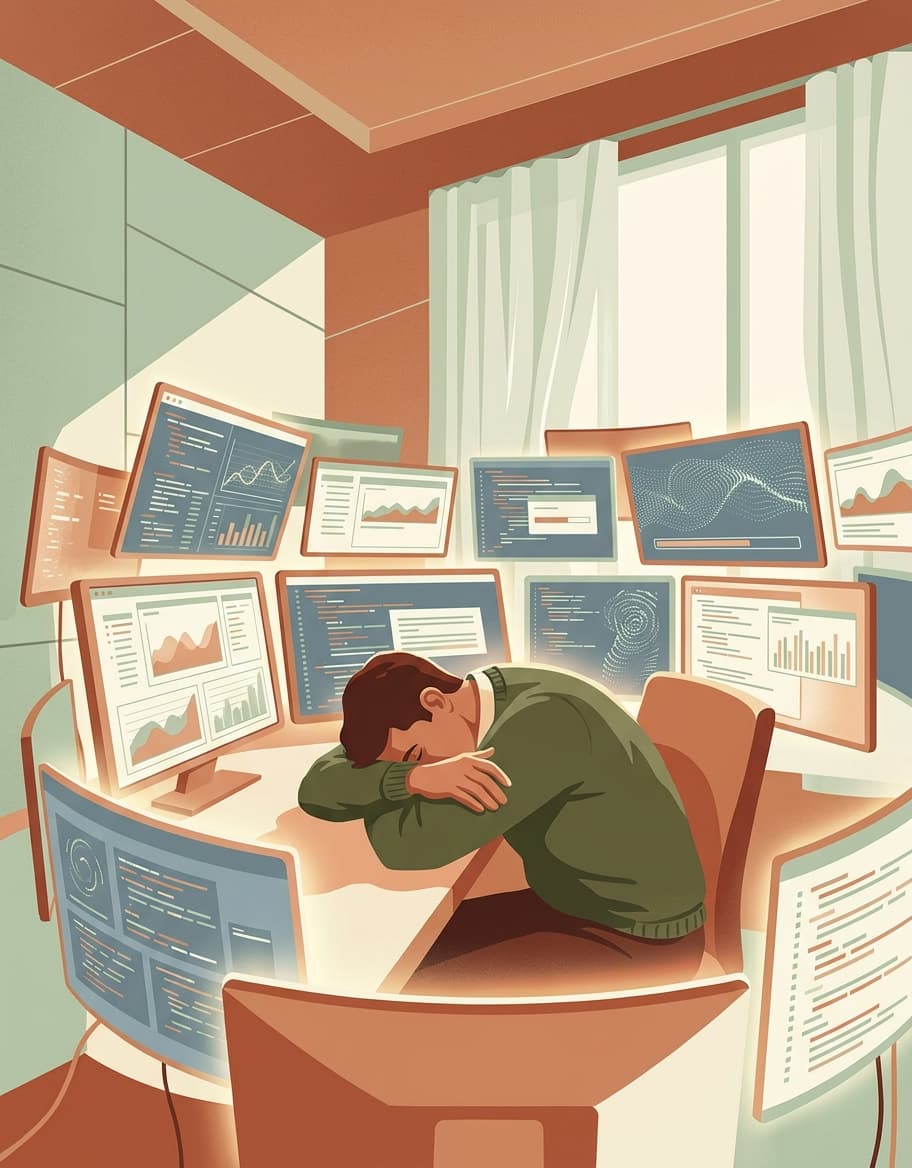
The Productivity Paradox: Why AI Is Making Us More Burnt Out, Not Less
AI collapsed the natural bottlenecks in knowledge work, and those bottlenecks were doing more than we realised. Why efficiency gains are producing burnout, not breathing room.
Everyone I speak to who uses AI seriously is more tired than they were before they started using it. The tools work, and that's kind of the problem.
We built AI to handle the operational weight of knowledge work: faster drafts, instant summarisation, code generation, research compilation, and clearing the low-value friction that used to consume hours of every working day. And it does all of that. The efficiency gains are real, measurable, and genuinely impressive. What nobody accounted for is what happens when you remove every bottleneck from a system that has been quietly relying on them to function.
The gaps were load-bearing
Where we once had natural constraints in the workflow, waiting for a brief to come back, waiting for a deck to be finished, waiting for research to be compiled, we now have none. AI collapsed the gaps, and those gaps, it turns out, were doing a lot of quiet structural work.
They were the moments we processed what we had just done before starting the next thing. They were the forced pauses that gave our attention time to reset. They were the points in the day where the work itself imposed a rhythm, not because we chose to rest, but because the workflow physically required it. The delay was not dead time. It was recovery time, and we didn't recognise it as such until it disappeared.
Cyril Northcote Parkinson observed in 1955 that work expands to fill the time available for its completion. What we are witnessing now is a variant that I think is more consequential: capacity expands to fill the tools available to it. When every bottleneck dissolves, the constraint on how much you can take on dissolves with it, and most AI power users respond not by protecting the time that's freed up but by immediately filling it with more work.
This pattern has a name
In 1865, the economist William Stanley Jevons noticed something counterintuitive about the steam engine. James Watt's improvements had made coal consumption dramatically more efficient, and the reasonable expectation was that Britain would use less coal as a result, but the opposite happened. Efficiency made coal-powered industry viable in sectors and at scales where it hadn't been before, and total consumption rose rather than fell.
The pattern became known as the Jevons Paradox, and it describes one of the most persistent dynamics in how humans respond to efficiency gains: we reinvest them as throughput rather than banking them as savings. Roads get widened and traffic increases. Email replaced memos, and we send 10 times as many messages. Faster internet did not mean less time online.
AI and knowledge work follow the same logic. The tool speeds up each task, so we take on more. A brief that used to take two days now takes an hour, and the response is not "you now have more breathing room" but "you can now run five briefs in parallel." Each one is faster, each one is individually manageable, and the cumulative cognitive load is heavier than anything we carried when the bottlenecks were still in place.
The evidence is accumulating
In 2024, Upwork's Research Institute surveyed 2,500 workers and C-suite leaders across the US, UK, Australia, and Canada and found that 77% of employees said AI tools had either maintained or increased their workload rather than reduced it. Nearly half had no idea how to achieve the productivity gains their employers expected. The tools were deployed, and expectations were raised. The support structures were not updated to match.
Microsoft's 2024 Work Trend Index reported a similar pattern from a different angle. 68% of knowledge workers reported struggling with the pace and volume of their work, and 46% described themselves as burned out. The heaviest AI users were also the most likely to feel overwhelmed, which makes sense once you understand that the people using AI the most are not using it to do less. They are using it to do more because that is what the system around them rewards and demands.
These numbers point to something structural rather than transitional. The burnout is not a temporary adjustment cost that will settle once we get used to the tools. It is a predictable consequence of removing constraints without replacing them.
What the gaps were actually for
The cognitive science on task switching has been consistent for decades. Every time you shift from one context to another, there is a measurable cost in time, accuracy, and mental energy. The cost is not dramatic for any single switch, but it compounds across a day, and what AI has done is dramatically increase the number of active contexts without reducing the switching cost between them.
Before AI, a typical knowledge worker might carry two or three active projects in a given week, with the bottlenecks in each one creating natural gaps where the brain could consolidate, process, and recover. Those gaps were not productive in the way we usually measure productivity, but they were doing important cognitive work: consolidating what had been learned, incubating ideas that needed time rather than effort, allowing the kind of diffuse thinking that researchers have linked to creative problem-solving and insight.
When every project can move at AI speed, the gaps collapse. You end up with five workstreams, all active simultaneously, each AI-assisted and therefore "manageable," and the continuous switching between them creates a sustained mental load with no real precedent in how knowledge work used to be structured.
The word "manageable" is doing a lot of dishonest work in this conversation. Each workstream is manageable in isolation. The total is not, and nobody is accounting for the total.
The rate limit
There is a dark irony in the fact that the most honest guardrail in the whole system might be the rate limit. When an AI tool tells you that you have hit your usage cap and need to wait, that enforced pause is doing something that nothing else in the workflow does: it stops throughput and creates a gap. It forces you to step away from the screen, and the work you come back to is almost always better for the interruption.
Nobody designed the rate limit as a wellbeing intervention. But it is functioning as one, and I think that tells us something important about where we are.
We built tools to eliminate every bottleneck in knowledge work, and we succeeded. Now we are discovering that some of those bottlenecks were not obstacles; they were structured and in rhythm. They were the thing that stopped the work from consuming everything.
The question is not whether to use AI. It is whether we rebuild the gaps intentionally, through deliberate choices about how much to carry and how fast to move, or whether we keep optimising for throughput until the people in the system break down faster than the tools can replace them.
The organisations that figure this out first will not be the ones that use AI the least. They will be the ones who understand what the gaps were for.